About Henry W. Longfellow
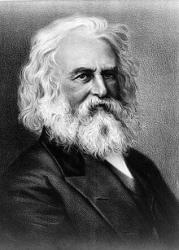
Henry Wadsworth Longfellow (1807–1882) stands as one of the most beloved figures in American literature, a member of the "Fireside Poets" whose verses became part of the cultural fabric of the 19th century. Born in Portland, Maine, and educated at Bowdoin College, Longfellow spent his professional life as a scholar of modern languages, first at Bowdoin and later at Harvard University. While he is primarily celebrated for epic poems like The Song of Hiawatha and Evangeline, his influence on hymnody is a result of his poetry's deep rhythmic and spiritual resonance rather than a specific intent to write for the church.
Although Longfellow never claimed to be a hymn writer, many of his poems were so profoundly moving and metrically precise that they were naturally adapted for congregational singing. Perhaps the most famous example is "A Psalm of Life" (1839), featuring the iconic line, "Life is real! Life is earnest!" This poem, intended as a call to action and moral purpose, appeared in numerous hymnals across the English-speaking world. His ability to translate complex European works also enriched the church; his translation of Jorge Manrique’s Spanish verses, "Alas, how poor and little worth," provided a poignant meditation on the fleeting nature of life.
Longfellow’s personal faith was deeply tied to his family and his sense of social justice. He wrote "Christ to the young man said" specifically for the ordination of his brother, Samuel Longfellow, who became a famous hymn writer in his own right. Another powerful contribution came from his poem "The Arsenal at Springfield," written after visiting an armory with his new bride. The closing stanzas, beginning "Down the dark future through long generations," were adapted into a hymn for peace, reflecting the anti-war sentiments that were brewing in mid-century America.
While not mentioned in the Julian excerpt, one of Longfellow’s most enduring spiritual legacies is the poem "I Heard the Bells on Christmas Day." Written during the American Civil War after his son was severely wounded and following the tragic death of his wife, the poem captures a raw struggle between despair and the "peace on earth" promised by the gospel. Today, it remains one of the most significant carols in the Christian repertoire. Longfellow’s reach was so vast that he became the first American to be honored with a bust in the Poets' Corner of Westminster Abbey, a testament to his status as a "household word" on both sides of the Atlantic.