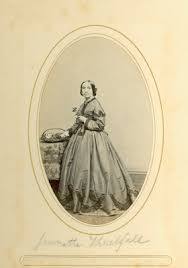
About Jennette Threlfall
Jennette Threlfall (1821–1880)
Jennette Threlfall was an English devotional poet and hymn writer whose life of suffering was marked by remarkable faith, patience, and quiet Christian witness. Though physically afflicted for much of her life, she became known for hymns that reflect childlike devotion, deep reverence for Christ, and simple yet heartfelt worship.
She was born on March 24, 1821, in Blackburn, the daughter of Henry Threlfall, a wine merchant, and Catherine Eccles. Orphaned at an early age, she was raised within extended family households and spent much of her life in caring environments that supported her through repeated hardships.
Her life was deeply marked by suffering. She experienced a serious accident that left her permanently disabled, and a second injury further increased her physical limitations, making her an invalid for the remainder of her life. Despite this, she was remembered for her cheerful spirit, kindness, and enduring faith.
She spent her later years in Westminster, where she continued to write devotional poetry. Her works were often published anonymously in magazines before being collected into volumes.
Literary works
Her poetry was first published in Woodsorrel; or, Leaves from a Retired Home (1856), issued under the initials “J. T.” Later, she expanded her work in Sunshine and Shadow, a collection that included both earlier and new devotional poems. A third edition appeared in 1880 shortly before her death.
Her poems were admired for their gentle tone, moral clarity, and devotional warmth, even if not highly elaborate in literary style. As one commentator noted, their strength lay in “a sweet spirit” rather than technical complexity.
The most widely known of these remains “Hosanna, Loud Hosanna,” which continues to be sung around the world, especially by children during Palm Sunday services.
Death and legacy
Jennette Threlfall died on November 30, 1880, and was buried in Highgate Cemetery.
Her legacy is not defined by physical strength or public prominence, but by spiritual endurance and the quiet power of praise in suffering. Through her hymns, she continues to teach the Church that worship can rise even from a place of weakness, and that joy in Christ is not dependent on circumstance, but on faith.