About Johann von Rist
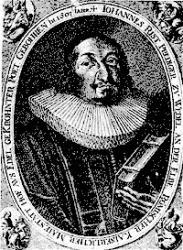
Johann Rist (1607–1667) stands as one of the most prolific and celebrated figures of the German Baroque. Born in Ottensen, near Hamburg, he was the son of a pastor and was dedicated to the ministry from birth. His education was exceptionally broad, spanning theology at Rinteln and Rostock, as well as Hebrew, mathematics, and medicine. This multidisciplinary background informed a career that was as much about secular intellectual leadership as it was about pastoral care.
A Patriarchal Life Amidst War
Rist spent the majority of his adult life as the pastor of Wedel, a town on the Elbe near Hamburg. Despite the pervasive terrors of the Thirty Years' War—during which he suffered from famine, plundering, and the pestilence—he maintained a "patriarchal" and highly influential presence. He was a true polymath, practicing medicine among his parishioners while simultaneously rising to the top of the German literary world. His honors were immense: Emperor Ferdinand III crowned him as a poet laureate in 1644 and raised him to the nobility in 1653. Rist also founded the "Order of the Elbe Swans," a literary society dedicated to the cultivation of the German language.
The Scope of His Hymnody
Rist was a staggering producer of sacred song, writing approximately 680 hymns. His goal was nothing less than a complete theological library in verse, intended to provide a spiritual soundtrack for every possible occasion of human life. While he originally intended many of these for private devotional use—they were reportedly never sung in his own church at Wedel during his lifetime—their high quality and classical style made them an immediate success across Germany. They were quickly set to music by the finest composers of the era, such as Johann Schop and Michael Jacobi.
Key Contributions to the Hymnal
Rist’s hymns are noted for their objective faith, scriptural depth, and a fervent, almost mystical love for the Savior. Several have become foundational to the global church:
-
"O Living Bread from Heaven" (Wie wohl hast du gelabet): A deeply revered Communion hymn that reflects Rist’s ability to combine theological precision with personal warmth.
-
"Arise, My Soul, Bless the Day" (Ermuntre dich, mein schwacher Geist): A cornerstone Christmas hymn, often used in festive settings and famously utilized in the works of Johann Sebastian Bach.
-
"O Jesu, Who in Sorrow Dying" (Jesu, der du meine Seele): A profound Lenten meditation on the forgiveness of sins, based on the devotional writings of Johann Arndt.
-
"All Ye Gentile Lands Awake" (Werde licht, du Stadt der Heiden): A classic Epiphany hymn celebrating the manifestation of Christ to the nations.
Legacy as the "Swann of Wedel"
Though some of his 680 hymns were criticized as bombastic or overly long, the best of Rist’s work remains in common use today. He represents the "Golden Age" of German hymnody, bridge-building between the starkness of the early Reformation and the more emotional Pietism that followed. His plays and secular poems provide a vivid historical record of the social conditions of the 17th century, but it is his "Heavenly Songs" (Himlischs Lieder) that ensure his place in history. He died in 1667, leaving behind a body of work that continues to "console, encourage, and strengthen" those who sing it.