About John Bowring
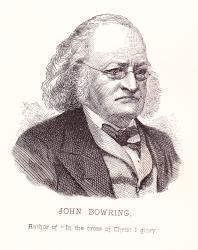
Sir John Bowring was a polymath of the Victorian era whose career spanned the worlds of high-stakes international diplomacy, radical politics, and linguistic scholarship. Born in Exeter in 1792, Bowring possessed an almost legendary facility for languages, eventually attaining a command of dozens of tongues. He leveraged this talent to become one of the most prolific translators of his age, publishing anthologies of Russian, Spanish, Dutch, Polish, and Magyar poetry, among others. His public life was equally distinguished; he served as a Member of Parliament, the editor of the Westminster Review, and eventually held high colonial offices as the Consul at Canton and the Governor of Hong Kong, for which he received a knighthood in 1854.
Despite his heavy involvement in the political and commercial affairs of the British Empire, Bowring maintained a deep and active devotional life as a member of the Unitarian denomination. His religious poetry was first introduced to the public in his celebrated volume Matins and Vespers (1823), which went through numerous expanded editions over several decades. His hymns are noted for their earnestness, deep devotion, and a universalist appeal that allowed them to transcend his own Unitarian circles and find a home in the hymnals of nearly every Christian denomination.
Among his most famous contributions to the global church is the majestic hymn "In the Cross of Christ I Glory," which famously treats the instrument of crucifixion not as a symbol of gloom, but as a "towering" source of peace and light. This hymn is a staple of Christian worship worldwide, alongside other classics such as the mission-focused "Watchman, Tell Us of the Night" and the comfort-filled "God Is Love, His Mercy Brightens." His ability to combine high literary quality with a profound sense of trust in God’s omnipresence made his work indispensable to 19th-century hymnody.
The sheer volume of Bowring's output is evidenced by his contribution of over eighty hymns to the Rev. J. R. Beard’s Collection in 1837. Many of these, such as "From the Recesses of a Lowly Spirit" and "How Sweetly Flowed the Gospel Sound," emphasize the internal, transformative power of faith and the accessibility of the divine presence. Sir John Bowring died in 1872, leaving behind a legacy that is perhaps unique in history: he was a man who navigated the complexities of international trade and war while simultaneously providing the church with some of its most serene and enduring songs of praise.