About Robert Robinson
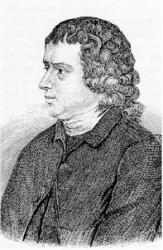
Robert Robinson (1735–1790) was one of the most brilliant, passionate, and ecclesiastically mercurial figures of the 18th-century English evangelical revival. Possessing an extraordinary, self-taught intellect and a fiery oratorical style, he rose from an impoverished, uneducated barber’s apprentice to become one of the premier dissenting theologians and preachers of his generation. While his prose was celebrated by both the Church of England and Nonconformists alike, his lasting monument remains a single, deeply personal hymn of grace that is sung by millions around the globe.
From Barber Shop to the Pulpit
Born into poverty in Swaffham, Norfolk, on September 27, 1735, Robinson lost his father at a young age. His godly mother hoped he might enter the Anglican ministry, but destitution forced her to apprentice the 14-year-old boy to a London hairdresser and barber. Robinson, however, was fundamentally "bookish." He neglected his scissors and combs in favor of reading every scrap of literature he could find.
In 1752, a teenage Robinson and his rowdy friends set out on a Sunday prank. They deliberately got a poor, fortune-telling woman drunk to laugh at her predictions. When she looked at Robinson, she soberly told him he would live to see his children and grandchildren. The comment deeply unsettled the young man, prompting him to abandon his carousing and go hear the famous open-air evangelist George Whitefield.
Whitefield's sermon on "the wrath to come" haunted Robinson for three long years until, at age 20, he found absolute peace through faith in Christ. He secretly recorded this spiritual rebirth in Latin on the blank leaf of one of his books:
"...Born in Swaffham... Born again on Saturday, May 24, 1752, through the powerful preaching of George Whitefield. And having tasted the pains of renewal for two years and seven months, I found full and free forgiveness through the precious blood of Jesus Christ (Tuesday, December 10, 1755)..."
The Scholarly Baptist of Cambridge
Robinson quickly realized his calling lay in preaching rather than hairdressing. Characterized by a restless, impulsive temperament, he moved through several denominations—preaching first as a Calvinistic Methodist, then joining the Independent (Congregational) church, and finally settling firmly within the Baptist tradition.
In 1759, he accepted a call to a tiny, struggling Baptist congregation at Stone Yard Church in Cambridge. Under his explosive, warm, and highly persuasive leadership, the church grew exponentially, eventually attracting university students and making the pulpit historically famous.
Robinson became a prolific author. His 1776 work, A Plea for the Divinity of our Lord Jesus Christ, was a masterpiece of orthodox theology, earning him urgent invitations from high-ranking bishops to conform to the Church of England—offers he flatly refused out of a fierce commitment to religious liberty. He also authored massive, authoritative histories on baptism and ecclesiology that remain vital academic resources.
Two Timeless Hymns
Robinson wrote only a small handful of hymns, but their enduring structural beauty and emotional resonance secured his place in hymnological history.
1. "Come, Thou Fount of Every Blessing" (1758)
Written when Robinson was just 22 years old for a Pentecost service, this hymn is a deeply autobiographical cry of gratitude for the relentless, chasing nature of divine grace. It captures the universal human struggle with spiritual inconsistency, featuring the famous, vulnerable lines:
"Prone to wander, Lord, I feel it, prone to leave the God I love; Here's my heart, O take and seal it, seal it for Thy courts above."
The hymn also introduced the distinct biblical phrase "Here I raise my Ebenezer," a direct reference to 1 Samuel 7:12, symbolizing a monument erected to mark a point where God had visibly provided rescue and help.
2. "Mighty God, While Angels Bless Thee" (1774)
Written later in his ministry, this robust, joyful hymn of praise celebrates the incarnation and cosmic sovereignty of Jesus Christ, blending theological weight with a driving, celebratory meter.
A Complex, Premature End
Robinson was a man of intense passion who burned out prematurely. In his later years, his theological stability wavered, and he began to express leanings toward Unitarianism. Worn out by decades of relentless writing and pastoral labor, he retired to Birmingham in 1790. There, he died suddenly in his sleep on June 9, 1790, at the age of 54.
Though his final years were clouded by theological ambiguity and administrative friction with his congregation, the evangelical world remembers him through the lens of his own youthful, brilliant poetry—as a wandering heart permanently sealed by grace.