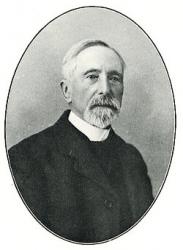
About S. Trevor Francis
Samuel Trevor Francis (1834–1925) was an English merchant, hymnwriter, and open-air preacher associated with the Plymouth Brethren. The son of an artist, he was born in Cheshunt, Hertfordshire, on November 19, 1834. Though he earned his living as a merchant in London, his true lifelong passion lay in religious poetry, open-air evangelism, and sacred music. A spiritually defining moment occurred during his teenage years when, while contemplating suicide on a London bridge, he experienced a profound spiritual conversion that set the course for his future ministry.
Samuel Trevor Francis. Source: Hymnology Archive
For over three decades, Francis wrote extensively for various religious newspapers and periodicals, establishing a reputation as a gifted devotional poet. His work gained notable recognition when ten of his pieces were compiled into the Enlarged London Hymn Book in 1873. These entries covered an array of liturgical themes, from the anticipatory celestial hope of "I am waiting for the dawning" and "Home, home of light and glory" to Christocentric pieces like "Jesus, we remember Thee." His earliest widely distributed piece, "The pearly gates are open," was published even earlier in William Carter’s Gospel Hymn Book (1863). Later in life, Francis compiled his poetic and scriptural reflections into the 1891 volume Gems from the Revised Version with Poems.
While his historical repertoire includes widely used pieces addressing Lent, baptism, and comfort for the grieving, Francis achieved his most enduring global legacy through the majestic hymn "O the Deep, Deep Love of Jesus" (traditionally sung to the Welsh tune Ebenezer). His lyrics consistently emphasized the vast, unmeasured nature of divine grace and the comforting assurance of salvation through Christ. Francis traveled extensively later in life, preaching the gospel in Great Britain, the United States, Canada, and Australia. He continued his spiritual work until his death on December 28, 1925, leaving a profound mark on evangelical hymnody.