About Sabine Baring-Gould
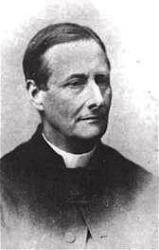
Sabine Baring-Gould (1834–1924) was an exceptionally prolific English hagiographer, antiquarian, novelist, and Anglican priest. The eldest son of Edward Baring-Gould, he was born in Exeter, Devon, on January 28, 1834. He received his higher education at Clare College, Cambridge, graduating with a Bachelor of Arts in 1857 and a Master of Arts in 1860. Deciding to enter the ministry, he took Holy Orders in 1864 and began his clerical career as the curate of Horbury, near Wakefield. His pastoral journey later led him to the incumbency of Dalton in Yorkshire (1867), the rectory of East Mersea in Essex (1871), and finally, in 1881, to his ancestral estate where he served as the squire and rector of Lew Trenchard in Devon.
Baring-Gould's literary and historical output was staggering, earning him a reputation as one of the most versatile scholars of the Victorian era. Among his most massive non-musical undertakings were the 15-volume Lives of the Saints (1872–1877), Curious Myths of the Middle Ages (1866–1868), and the highly regarded philosophical text The Origin and Development of Religious Belief (1869–1870), alongside numerous collections of regional folklore, traditional folk songs, and sermon books.
Within the realm of hymnology, Baring-Gould is universally remembered for penning some of Christendom's most iconic processional anthems. His most famous original composition is "Onward, Christian Soldiers" (1865), written as a rhythmic marching song for children moving between villages during a regional festival. He achieved similar fame with his robust translation of Bernhardt S. Ingemann’s Danish text, "Through the night of doubt and sorrow," and the tender evening prayer "Now the day is over." His musical works appeared regularly in the Church Times, The People's Hymnal (1867), and various editions of Hymns Ancient & Modern. Later in his career, he focused heavily on regional carols and liturgical music, compiling his original pieces into Church Songs (1884) and preserving early regional variants in a dedicated study of the traditional Noels of French Flanders. He passed away on January 2, 1924, leaving behind a monumental legacy in English folk tradition, literature, and church music.