About Samuel Medley
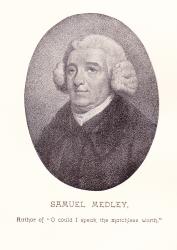
Samuel Medley (1738–1799) was an esteemed English Baptist minister, sailor, and hymnist whose vibrant life journey from the Royal Navy to the pulpit deeply colored his poetic catalog. Born on June 23, 1738, in Cheshunt, Hertfordshire, where his father operated a school, Medley received a strong classical education. Resisting the business apprenticeship chosen for him, he instead entered the Royal Navy as a young man. His military career was violently interrupted in 1759 during a major battle with the French fleet off Port Lagos, where he sustained a severe leg wound. Forced to retire from active duty, his convalescence became a spiritual turning point. While recovering, he heard a sermon by Isaac Watts that sparked a profound religious conversion. He formally entered Christian ministry, pastoring a Baptist church in Watford in 1767 before moving to Byrom Street, Liverpool, in 1772. There, Medley gathered a vast congregation and spent 27 highly influential years as an exceptionally popular evangelical preacher until his death on July 17, 1799.
Initially printed on individual leaflets or in publications like the Gospel Magazine, Medley's hymns were later compiled into several volumes, including his first 42-hymn collection in Bradford (1785) and the comprehensive, posthumous Hymns (1800). His work found immense popularity within Baptist circles, especially among the more Calvinistic churches, holding prominent placement in major denominational indices. Hymnologists noted that the enduring charm of Medley’s verse relied less on complex literary artistry and more on the warmth, emotional pathos, and experimental depth with which he articulated the Christian life. A hallmark feature of his writing style was the effective use of a recurring refrain or repeated exclamation in the final line of each stanza, driving home the central theme with rhythmic intensity.
Medley’s hymnological catalog boasts several classic texts that became staples of English and American Protestant worship. Among his most celebrated and enduring pieces are:
-
"O could I speak the matchless worth" – A soaring anthem of Christological praise that remains his most widely sung masterpiece across denominations.
-
"Mortals, awake, with angels join" – A jubilant and descriptive Christmas carol celebrating the incarnation.
-
"Hear, gracious God! a sinner's cry" – A deeply moving, penitential prayer of confession frequently used for Lenten services.
-
"Now, in a song of grateful praise" – A spirited song of thanksgiving first published in 1776.
The historical preservation of his legacy encountered unique family drama decades after his passing. While his son published an authoritative Memoir in 1800, his daughter, Sarah Medley, published a competing biography in 1833. To her edition, she appended 52 communion hymns which she attributed entirely to her father; however, subsequent scholarship definitively revealed that she had secretly altered and slipped in eight hymns written by the prominent Irish hymnist Thomas Kelly. Despite these later editorial complications, Medley’s authentic verses secured his standing as a vital voice of the eighteenth-century evangelical revival.