About St. Ambrose
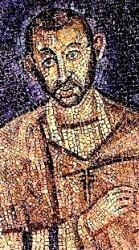
Saint Ambrose (c. 340–397), known historically as Aurelius Ambrosius, was one of the four original Latin Fathers of the Church, a brilliant statesman, a fierce opponent of heresy, and the undisputed "Father of Church Song" in the Western world. Born into Roman nobility at Treves (modern Trier, Germany) around 340, his father served as the Prefect of the Gauls. Following his father's early death, Ambrose was educated in Rome, mastering law and Greek. His sharp administrative intellect brought rapid political advancement, culminating in his appointment in 374 as the Consular governor of Liguria and Emilia, a position based in the imperial capital of Milan.
From Governor to Bishop in a Week
In late 374, Auxentius, the Bishop of Milan and a leader of the Arian faction—which denied the full divinity of Jesus Christ—passed away. The election of a successor threatened to erupt into bloody civil rioting between orthodox Nicene Christians and Arians. Ambrose entered the packed cathedral strictly as a magistrate to preserve public order. While he was addressing the crowd, a child's voice suddenly rang out through the sanctuary: "Ambrose is Bishop!"
The entire assembly instantly took up the cry. Ambrose, who was merely a catechumen (a believer undergoing instruction) and not yet baptized, was horrified and attempted to flee the city. The Emperor Valentinian I, however, approved the election. In an astonishingly swift canonical sequence, Ambrose was baptized, ordained through the holy orders, and consecrated as Bishop of Milan on December 7, 374, all within the span of a single week.
Church and State Clash
As bishop, Ambrose proved to be a towering ecclesiastical force, establishing a definitive precedent for the independence of the Church over the Roman Empire.
-
The Arian Crisis: He fiercely resisted the Arian Empress Justina, leading his congregation in a non-violent, weeks-long occupation of the Milan basilicas when imperial troops attempted to seize them for heretical use.
-
The Imperial Penance: In 390, after the Emperor Theodosius ordered a brutal massacre of 7,000 citizens in Thessalonica following a riot, Ambrose met the emperor at the church doors and barred him from entry. Ambrose forced the most powerful ruler in the Western world to strip off his royal robes and perform public penance for eight months before granting him Holy Communion at Christmas.
Ambrose’s brilliant preaching and profound theological depth made him a magnetic figure. In 387, his most famous disciple, a disillusioned rhetorician named Augustine of Hippo, was won over by Ambrose’s intellect and baptized by his hand.
The Father of Western Hymnody
Before Ambrose, congregational singing in the West was largely unformed. To keep his congregation awake and spiritually fortified during their long sanctuary vigils against the imperial army, Ambrose introduced two musical revolutions from the Eastern Church: metrical hymnody and antiphonal chanting (choirs singing alternating verses back and forth).
Ambrose designed his hymns with structural perfection to teach complex theology to everyday peasants. He discarded intricate classical meters in favor of a sturdy, easily learned rhythm: Iambic Dimeter (stanzas of four lines, with eight syllables per line, known today as Long Meter). This clean, unyielding structure became the foundational architecture for all Western Christian hymnody.
While medieval tradition attributed nearly a hundred hymns to him—including a beautiful legend that he and St. Augustine spontaneously composed the Te Deum responsively on the night of Augustine's baptism—modern scholarship confidently recognizes only twelve as authentic.
| Famous Authentic Ambrosian Hymns | Theological Context / Traditional Liturgical Use |
| Veni Redemptor gentium | "Come, Thou Redeemer of the Earth" – His definitive Advent masterpiece, explicitly asserting Christ’s dual human-divine nature against Arianism. |
| Splendor Paternae gloriae | "Splendor of God's Glory Bright" – A radiant, daily morning hymn celebrating Christ as the true spiritual morning sun. |
| Deus Creator omnium | "Creator of the Earth and Sky" – A serene evening text focused on physical rest and spiritual vigilance. |
| Aeterne rerum Conditor | "Maker of All, Eternal King" – A historic dawn text traditionally sung at the crowing of the rooster. |
Veni Redemptor gentium (Ambrose's Original Latin Framework)
Veni, Redemptor gentium,
Ostende partum Virginis;
Miretur omne saeculum:
Talis decet partus Deum.
Worn out by intense political diplomatic missions and endless pastoral labor, Ambrose passed away on Easter Eve, April 4, 397. He left behind a church that had successfully broken the back of early heresies, a blueprint for the separation of church and state, and a simple, rhythmic style of congregational praise that continues to echo through church sanctuaries sixteen centuries later.