About Stopford A. Brooke
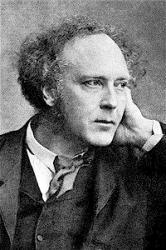
Stopford Augustus Brooke (1832–1916) was an Irish-born divine, man of letters, and chaplain to Queen Victoria whose theological journey led him from the vanguard of the Broad Church movement in the Church of England to a highly publicized secession into independent, Unitarian-aligned ministry. A brilliant literary critic and hymnologist, his original compositions are celebrated for their great freshness of thought, lyrical tenderness, and deep engagement with nature and the human experience.
Academic Distinction and Royal Favor
Born at Letterkenny, County Donegal, Ireland, on November 14, 1832, Brooke was educated at Trinity College, Dublin. His early literary brilliance was marked by winning both the Downes prize and the Vice-Chancellor's prize for English verse before graduating with his B.A. in 1856 and M.A. in 1858.
Upon taking Holy Orders in the Church of England, he quickly rose through the ecclesiastical ranks in London, serving a series of prominent curacies and ministries:
-
1857–1859: Curate of St. Matthew's, Marylebone
-
1860–1863: Curate of Kensington
-
1863–1865: Chaplain to the British Embassy at Berlin, where he won the favor of the Crown Princess Victoria (the Princess Royal)
-
1866–1875: Minister of St. James's Chapel, York Street, London
His rising fame as a captivating preacher and intellectual giant culminated in 1872 when he was appointed Chaplain in Ordinary to Queen Victoria. Simultaneously, Brooke established himself as an eminent literary biographer and historian, publishing the definitive Life and Letters of the late F. W. Robertson (1865), Theology in the English Poets (1874), and his wildly successful Primer of English Literature (1876), which sold nearly half a million copies during his lifetime.
The Great Rupture: Secession from the Established Church
As the 1870s progressed, Brooke found himself increasingly at variance with orthodox Anglican dogmas. He rejected traditional doctrines concerning eternal punishment, the miraculous, and strict formulation of the Trinity, feeling that the Church's ancient creeds restricted spiritual liberty and intellectual honesty.
In 1880, Brooke made the agonizing decision to secede from the Church of England, surrendering his royal chaplaincy. He retained the lease of Bedford Chapel in Bloomsbury, where a large, fiercely loyal portion of his congregation followed him. Operating as an independent preacher with strong Unitarian leanings, his chapel became a center for London's radical intellectual elite.
Contribution to Hymnology: Christian Hymns (1881)
To provide a liturgical framework that harmonized with his newly liberated theological views, Brooke compiled and published Christian Hymns (1881), a collection of 269 pieces, for the use of his congregation.
Brooke treated hymnody as a fluid art form. He famously made extensive alterations to traditional texts and inserted original stanzas into well-known lyrics to strip them of rigid dogmatism, softening them with an emphasis on divine love, human sympathy, and the spiritual presence in nature.
The collection also showcased his own exceptional talent as a hymn writer. His original pieces were quickly recognized for their unique poetic quality, frequently crossing over into mainstream collections like Horder’s Congregational Hymns (1884) and The Norwood Hymnal.
Key Original Compositions & Hymnic Analysis
| Hymn First Line | Theme / Liturgical Focus | Critical Notes |
| When the Lord of Love was here | The Life and Ministry of Christ | Universally regarded as Brooke’s finest hymn. It avoids abstract theological mechanics, focusing instead on the historical, earthly Jesus healing and comforting humanity. |
| Immortal Love, within Whose righteous will | Resignation & Divine Guidance | Written in the same meter as Cardinal Newman’s "Lead, kindly Light," it stands as a companion hymn of profound personal surrender to the divine will. |
| Let the whole creation cry | Universal Invitation to Praise | A spirited, joyous imitation of Psalm 148, celebrated for its poetic merit and rhythmic vitality. |
| It fell upon a summer day | Christ Blessing Little Children | A tender, expansive narrative hymn running 10 stanzas, emphasizing Christ’s approachability and love for youth. |
| It is finished, all the pain | Good Friday | A striking Passion hymn that reframes the Crucifixion through the lens of human suffering and relief from earthly torment. |
| Now that day its wings has furled | Evening / Dusk | A gentle, evocative evening hymn using vivid nature imagery typical of Brooke’s background in poetry. |
When the Lord of Love was here (Stanza I & II)
When the Lord of Love was here,
Happy hearts to Him were dear,
Though His heart was sad;
Down the vale of life He went,
Full of compassionate intent,
Making people glad.
He was full of grace and truth,
Loving childhood, loving youth,
Pitiful to age;
Wondrous words of life He spoke,
Wondrous deeds of power He wrought,
All our grief to assuage.
Brooke continued to write, lecture, and preach with artistic vigor until Bedford Chapel was demolished in 1894. He spent his remaining decades painting, writing literary criticism on Shakespeare and Browning, and enjoying the natural world he loved deeply until his death at Ewhurst, Surrey, on March 18, 1916. His hymns remain an enduring testament to a mind that sought to marry the precision of English literature with the freedom of a modernizing faith.