



The Christian Was Never Meant to Walk Alone
5 days, 16 hours ago
Peace, Perfect Peace
Lyrics
1. Peace, perfect peace, in this dark world of sin?
The blood of Jesus whispers peace within.
The blood of Jesus whispers peace within.
2. Peace, perfect peace, by thronging duties pressed?
To do the will of Jesus, this is rest.
To do the will of Jesus, this is rest.
3. Peace, perfect peace, with sorrows surging round?
On Jesus' bosom naught but calm is found.
On Jesus' bosom naught but calm is found.
4. Peace, perfect peace, our future all unknown?
Jesus we know, and He is on the throne.
Jesus we know, and He is on the throne.
5. Peace, perfect peace, death shadows us and ours?
Jesus has vanquished death and all its pow'rs.
Jesus has vanquished death and all its pow'rs.
6. It is enough; earth's struggles soon shall cease,
and Jesus, call to heav'n's perfect peace.
and Jesus, call to heav'n's perfect peace.
Bible Reference
Isaiah 26:3
About This Hymn
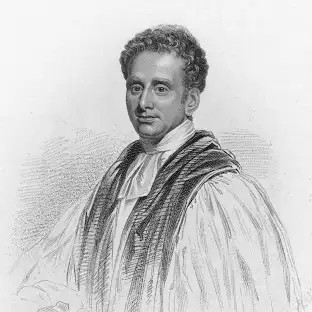
Author – Edward H. Bickersteth (1825–1906)
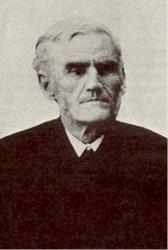
Composer – George T. Caldbeck (1852–1918)
Tune Name – “Pax Tecum”
Meter – 10 10
Scripture Reference – Isaiah 26:3; John 16:33 (KJV)
"Peace, perfect peace, in this dark world of sin?" With this gentle yet probing question, Edward H. Bickersteth opens one of the most beloved hymns of quiet assurance in the Christian tradition. Composed in 1875, this hymn addresses the turmoil, sorrow, uncertainty, and loneliness that so often afflict the human heart. Yet rather than dwelling on despair, each question is met with a calm, scriptural response—always centering on the sufficiency and presence of Christ. Whether it is the burden of earthly duties, the ache of separation from loved ones, or the shadow of death, the hymn leads the singer to rest in the promises of God. It stands as a pastoral dialogue between the soul and Scripture, a testament to the peace that Christ alone provides. The refrain echoes the words of Jesus from John 16:33: “These things I have spoken unto you, that in me ye might have peace. In the world ye shall have tribulation: but be of good cheer; I have overcome the world.”
Edward Henry Bickersteth was born in London on January 26, 1825, into a distinguished clerical family. His father, the elder Edward Bickersteth, was a missionary to West Africa and later a significant leader within the Church Missionary Society, as well as a respected poet and hymnal editor. Edward Jr. followed a similar path of ministry and literary service. After completing his education at Trinity College, Cambridge, he was ordained in 1848 and eventually rose to become the Bishop of Exeter (1885–1900). Throughout his ministry, Bickersteth was recognized as a leading evangelical voice within the Church of England. His literary output included numerous volumes of poetry, sermons, and hymns, and he served as editor of The Hymnal Companion to the Book of Common Prayer, which became a widely used evangelical hymnal throughout Great Britain. Like his father, he held a deep love for hymnody, using it as a means to communicate both theology and comfort to the church.
The inspiration for “Peace, Perfect Peace” came during a Sunday in August 1875, while Bickersteth was on holiday in the spa town of Harrogate. That morning, he heard a sermon preached by Canon Gibbon on Isaiah 26:3: “Thou wilt keep him in perfect peace, whose mind is stayed on thee: because he trusteth in thee.” The preacher noted that in Hebrew, the phrase “perfect peace” was actually shalom shalom—a doubled expression conveying the idea of complete and absolute peace. Deeply moved by the message, Bickersteth carried it in his heart throughout the day. That afternoon, he visited a dying relative, Archdeacon Hill of Liverpool, who was deeply agitated and troubled in spirit. Hoping to bring comfort, Bickersteth read from the same Scripture and then, drawing paper from a nearby desk, quickly composed the stanzas of the hymn. Each couplet posed a pressing question of the heart, and each was answered with calm faith: “It is enough: earth’s struggles soon shall cease, and Jesus call us to Heaven’s perfect peace.” It is said that Bickersteth never revised the lines afterward—the words that comforted a dying man have continued to bring solace to generations ever since.
The tune that has become inseparable from this hymn, “Pax Tecum”—Latin for “Peace be with you”—was composed in 1877 by George T. Caldbeck, a young missionary student. The melody's simple structure matches the tone of the text perfectly. The first line of each stanza, posed as a question, remains soft and steady with a two-note motif, while the answering line rises and gently descends, mirroring the emotional lift and resolution found in the promise of peace. The hymn lends itself to antiphonal singing, with one part of a congregation asking the question and another answering with confident faith. This interactive structure has helped the hymn remain fresh and engaging in both corporate and private worship.
The enduring power of “Peace, Perfect Peace” lies in its ability to minister directly to troubled hearts. It does not offer peace as the absence of trial, but rather as the presence of Christ amid every trial. The hymn reminds believers that whether in moments of pressure, grief, separation, or uncertainty, the peace of God is still available—and it is perfect. From its origin at a deathbed to its adoption in hymnals across the English-speaking world, this hymn continues to offer the same comfort it first gave in 1875: a reassurance that the Prince of Peace has overcome the world.
Author – Edward H. Bickersteth (1825–1906)
Composer – George T. Caldbeck (1852–1918)
Tune Name – “Pax Tecum”
Meter – 10 10
Scripture Reference – Isaiah 26:3; John 16:33 (KJV)
"Peace, perfect peace, in this dark world of sin?" With this gentle yet probing question, Edward H. Bickersteth opens one of the most beloved hymns of quiet assurance in the Christian tradition. Composed in 1875, this hymn addresses the turmoil, sorrow, uncertainty, and loneliness that so often afflict the human heart. Yet rather than dwelling on despair, each question is met with a calm, scriptural response—always centering on the sufficiency and presence of Christ. Whether it is the burden of earthly duties, the ache of separation from loved ones, or the shadow of death, the hymn leads the singer to rest in the promises of God. It stands as a pastoral dialogue between the soul and Scripture, a testament to the peace that Christ alone provides. The refrain echoes the words of Jesus from John 16:33: “These things I have spoken unto you, that in me ye might have peace. In the world ye shall have tribulation: but be of good cheer; I have overcome the world.”
Edward Henry Bickersteth was born in London on January 26, 1825, into a distinguished clerical family. His father, the elder Edward Bickersteth, was a missionary to West Africa and later a significant leader within the Church Missionary Society, as well as a respected poet and hymnal editor. Edward Jr. followed a similar path of ministry and literary service. After completing his education at Trinity College, Cambridge, he was ordained in 1848 and eventually rose to become the Bishop of Exeter (1885–1900). Throughout his ministry, Bickersteth was recognized as a leading evangelical voice within the Church of England. His literary output included numerous volumes of poetry, sermons, and hymns, and he served as editor of The Hymnal Companion to the Book of Common Prayer, which became a widely used evangelical hymnal throughout Great Britain. Like his father, he held a deep love for hymnody, using it as a means to communicate both theology and comfort to the church.
The inspiration for “Peace, Perfect Peace” came during a Sunday in August 1875, while Bickersteth was on holiday in the spa town of Harrogate. That morning, he heard a sermon preached by Canon Gibbon on Isaiah 26:3: “Thou wilt keep him in perfect peace, whose mind is stayed on thee: because he trusteth in thee.” The preacher noted that in Hebrew, the phrase “perfect peace” was actually shalom shalom—a doubled expression conveying the idea of complete and absolute peace. Deeply moved by the message, Bickersteth carried it in his heart throughout the day. That afternoon, he visited a dying relative, Archdeacon Hill of Liverpool, who was deeply agitated and troubled in spirit. Hoping to bring comfort, Bickersteth read from the same Scripture and then, drawing paper from a nearby desk, quickly composed the stanzas of the hymn. Each couplet posed a pressing question of the heart, and each was answered with calm faith: “It is enough: earth’s struggles soon shall cease, and Jesus call us to Heaven’s perfect peace.” It is said that Bickersteth never revised the lines afterward—the words that comforted a dying man have continued to bring solace to generations ever since.
The tune that has become inseparable from this hymn, “Pax Tecum”—Latin for “Peace be with you”—was composed in 1877 by George T. Caldbeck, a young missionary student. The melody's simple structure matches the tone of the text perfectly. The first line of each stanza, posed as a question, remains soft and steady with a two-note motif, while the answering line rises and gently descends, mirroring the emotional lift and resolution found in the promise of peace. The hymn lends itself to antiphonal singing, with one part of a congregation asking the question and another answering with confident faith. This interactive structure has helped the hymn remain fresh and engaging in both corporate and private worship.
The enduring power of “Peace, Perfect Peace” lies in its ability to minister directly to troubled hearts. It does not offer peace as the absence of trial, but rather as the presence of Christ amid every trial. The hymn reminds believers that whether in moments of pressure, grief, separation, or uncertainty, the peace of God is still available—and it is perfect. From its origin at a deathbed to its adoption in hymnals across the English-speaking world, this hymn continues to offer the same comfort it first gave in 1875: a reassurance that the Prince of Peace has overcome the world.
From the Dictionary of Hymnology
Related terms and concepts automatically matched to this hymn.
Abide in me, and I in you Hymnology
A publication trace of Bishop Edward Henry Bickersteth's devotional hymn on abiding in Christ, covering its initial 1849 composition and subsequent nineteenth-century printings.
Read moreA beautiful land by faith I see Hymn
A popular nineteenth-century Sunday School hymn about Heaven, first published anonymously in 1862 and later attributed to J. Hall.
Read moreAgain our ears have heard the voice History
Hymnological profile of James Montgomery's nineteenth-century hymn for the close of Divine Service, "Again our ears have heard the voice."
Read more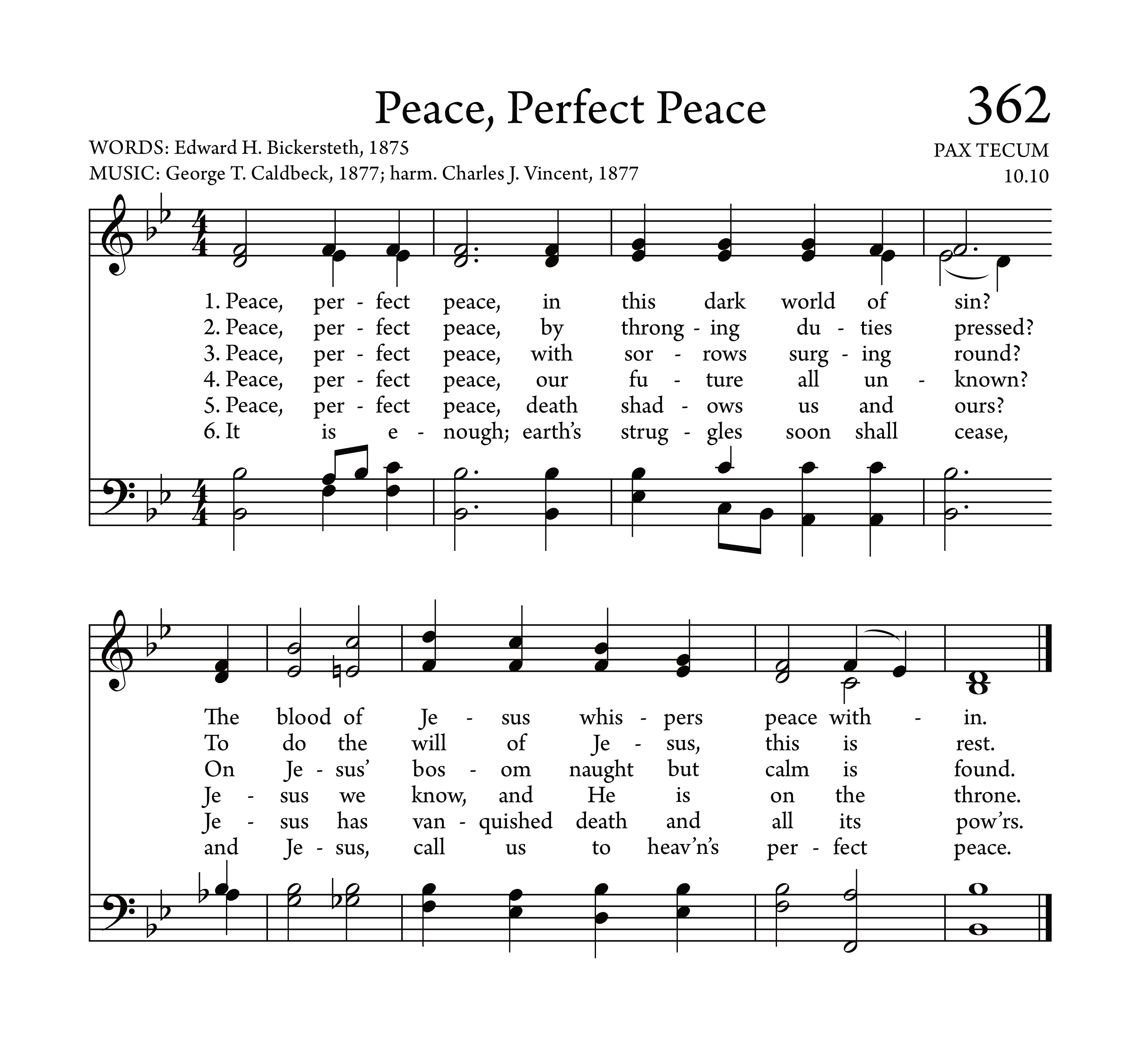

📬 Subscribe to Our Devotional Updates
Receive weekly hymns, devotionals, and website features directly in your inbox.
✅ Thank you! You'll start receiving our updates soon.
⭐ Recommend This Hymn
Share this beautiful hymn with others
This hymn is found in these hymnals
Open the hymnal that contains this hymn:
Hymns with the same subject
More hymns about Blood of Christ, Peace
- How Deep the Father's Love for Us — Stuart Townend
- The Old Rugged Cross — George Bennard
- I’ve Got the Joy, Joy, Joy, Joy (Down in My Heart) — George W. Cooke
- In Christ alone (my hope is found) — Stuart Townend
- Victory in Jesus - (I Heard an Old, Old Story) — E. M. Bartlett
- There Is Power in the Blood — Lewis E. Jones
- Let There Be Peace on Earth — Jill Jackson-Miller
- Come, Thou Fount of Every Blessing — Robert Robinson
More hymn subjects
Explore other themes across the library.
Hymns about Guidance
Hymns about Mission
Hymns about Scripture
Hymns about Glory of God
Hymns about Praise
Hymns about Trinity
Hymns about Thanksgiving
Hymns about Gratitude
Browse all subjects →
Latest Updated Hymnals
-
Open
 The People's HymnalUpdated 4 days, 21 hours ago · 1961
 -
Open
 Book of Common Praise (BoCP1915)Updated 2 weeks, 5 days ago · 1915
 -
Open
 Our Great Redeemer's PraiseUpdated 2 months, 2 weeks ago · 2022
 -
Open
 The Parish Hymnal (1873)Updated 2 months, 2 weeks ago · 1873
 -
Open
 Book of Common Praise (BCP1998)Updated 3 months ago · 1998
Hymn Information
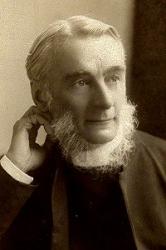
To view the author's biography, click their name above.
MIDI File
Ready to load
Download MIDI
More Hymns by Edward Henry Bickersteth
Popular Hymns
Recent Blog Posts



Popular Blog Posts
-
 Easter vs Passover: How a Biblical Feast Bec…3 months, 4 weeks ago
 -
 Lessons from the Book of Haggai: Putting God…2 months ago
 -
 The Full Story of the Birth of Jesus Christ:…7 months, 3 weeks ago
 -
 The 30 Most Famous Christmas Hymns and Carols11 months ago
 -
 50 Most Sung Hymns Today: the Most Beloved S…8 months, 1 week ago
Visit Us on Social Media
Latest from X (Twitter)
Tweets by HymnalLibraryLatest from Facebook
Latest on YouTube
Loading latest video...
Daily Bible Verse
Disclaimer
The hymns, sheet music, MIDI files, and related content on this website are provided for educational and research purposes only.
- Public Domain: Many of the hymns featured here are in the public domain and may be freely used.
- Copyrighted Works: Some hymns may still be under copyright protection. Where applicable, permission has either been requested from the copyright owner, or the content is shared under the principles of fair use for educational purposes.
⚠️ Important Notice: If you wish to reproduce, distribute, or use any copyrighted hymn beyond personal study or educational use, you must obtain permission directly from the copyright holder. This website does not grant any rights for commercial use yet.
If there is any other question please address it to us in our Contact Page, for further assistance. Thank you for using the site. May God Bless You.
Recently Added · Dictionary of Hymnology
Browse dictionary →- All hail, dear Conqueror, all hail 5 days, 17 hours ago · History 51
- All glory to our gracious Lord 5 days, 20 hours ago · History 46
- All glory to God in the sky 5 days, 20 hours ago · History 51
- All glory and praise to Jesus our Lord 5 days, 20 hours ago · History 63
- All glorious God, what hymns of praise 5 days, 20 hours ago · History 51